Most neuroscience studies of language do not study conversation directly. They often focus on people listening to isolated sentences, reading words, or producing speech in controlled tasks. These approaches are useful, but they miss something central about everyday language: conversation is interactive. We listen, speak, predict, interrupt, wait, overlap, and coordinate with another person in real time.
DUET was created to make this kind of interaction easier to study.
DUET, short for Dyadic Understanding, EEG and Turn-taking, is a dual-EEG hyperscanning dataset of natural French face-to-face conversation. In the study, 36 native French speakers formed 18 dyads and completed a collaborative spot-the-difference task while EEG was recorded simultaneously from both participants. Each dyad completed eight 4-minute conversations, producing a dataset designed to capture live dialogue rather than isolated comprehension or production.
A central feature of DUET is that it combines neural recordings with rich conversational annotations. The speech was manually corrected and time-aligned, with annotation layers for phonemes, syllables, words, inter-pausal units, and turn structure. The dataset also includes derived acoustic and linguistic features such as speech envelope, pitch, formants, part-of-speech tags, word surprisal, and entropy. These layers make it possible to ask many different questions about how speech, language, and interaction unfold over time.
Because raw conversational audio can identify participants by voice, the public release does not include the original waveform audio. Instead, DUET provides de-identified annotations and derived features aligned to the EEG recordings. This keeps the dataset useful for speech and language neuroscience while reducing privacy risks.
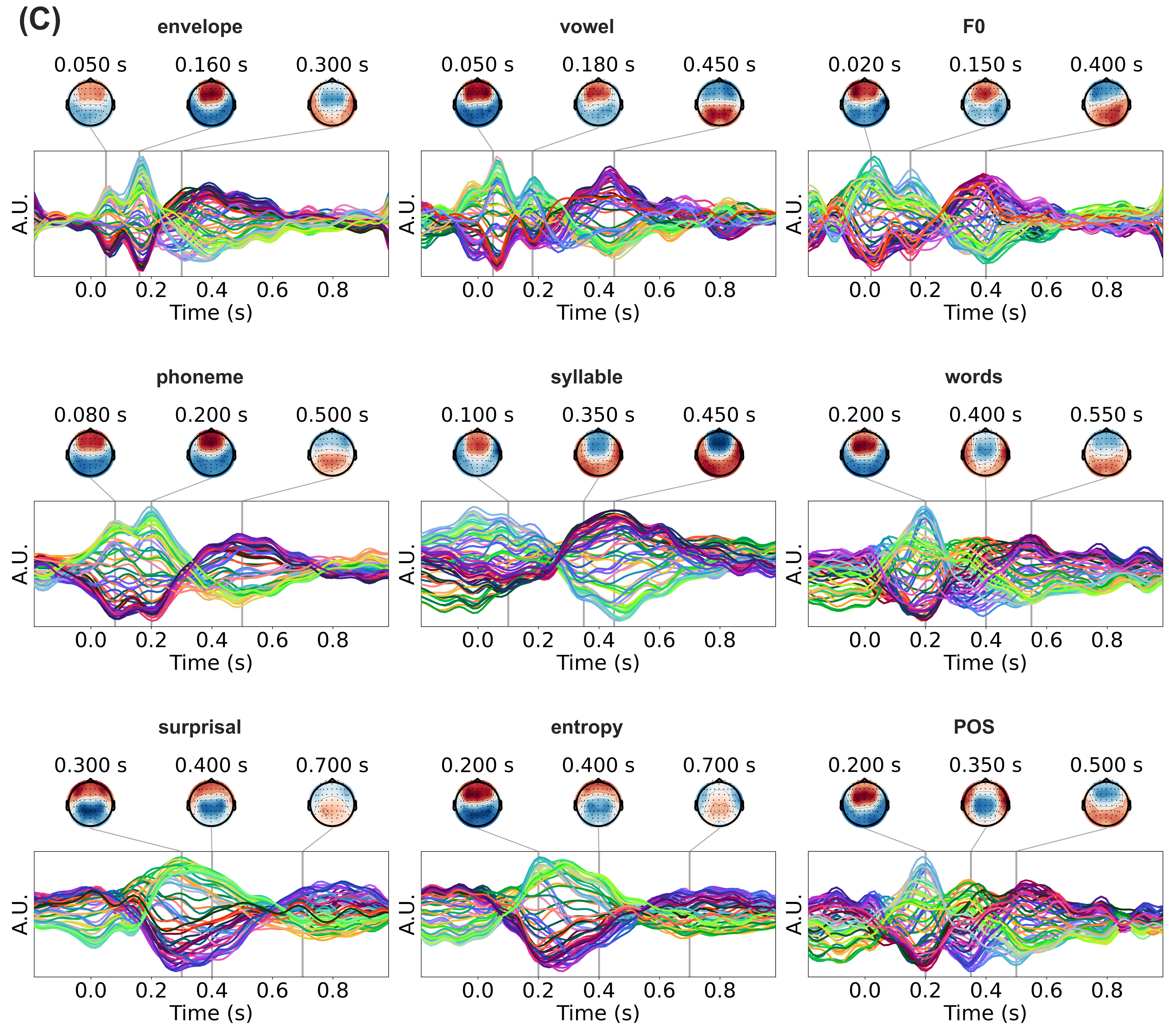
The dataset is organised in BIDS format and includes raw EEG recordings, metadata, annotation files, feature derivatives, and precomputed ICA decompositions that users can inspect or reuse for preprocessing. We also validated the dataset with temporal response function analyses, showing that speech-aligned features can reliably predict EEG activity under a standard continuous encoding framework. In other words, the timing, annotations, and neural data are aligned well enough to support modern naturalistic speech-brain analyses.
DUET is intended as a reusable resource for researchers interested in turn-taking, speaker-listener coordination, speech planning, naturalistic listening, and dyadic interaction. More broadly, it supports a shift from studying language as an isolated process toward studying language as something people do together.