When people talk to each other, they often become more similar over time. They may start using similar words, grammatical structures, gestures, or even accents. One especially interesting form of this alignment is speech rate: whether speakers adjust how fast they talk based on how fast their partner has just spoken.
In this study, we asked whether speech-rate alignment happens locally during natural conversation, and what kind of neural processes might support it.
We analysed face-to-face French conversations recorded with dual EEG. Participants completed a collaborative spot-the-difference task, which encouraged natural dialogue and frequent turn-taking. We divided the conversations into short speech segments and asked a simple behavioural question: does one person's speech rate predict the other person's speech rate in the next turn?
The answer was yes. Speakers tended to talk faster after their partner had just spoken faster, and slower after their partner had spoken slower. This suggests that conversational partners adapt their speaking tempo rapidly, at the scale of adjacent turns.
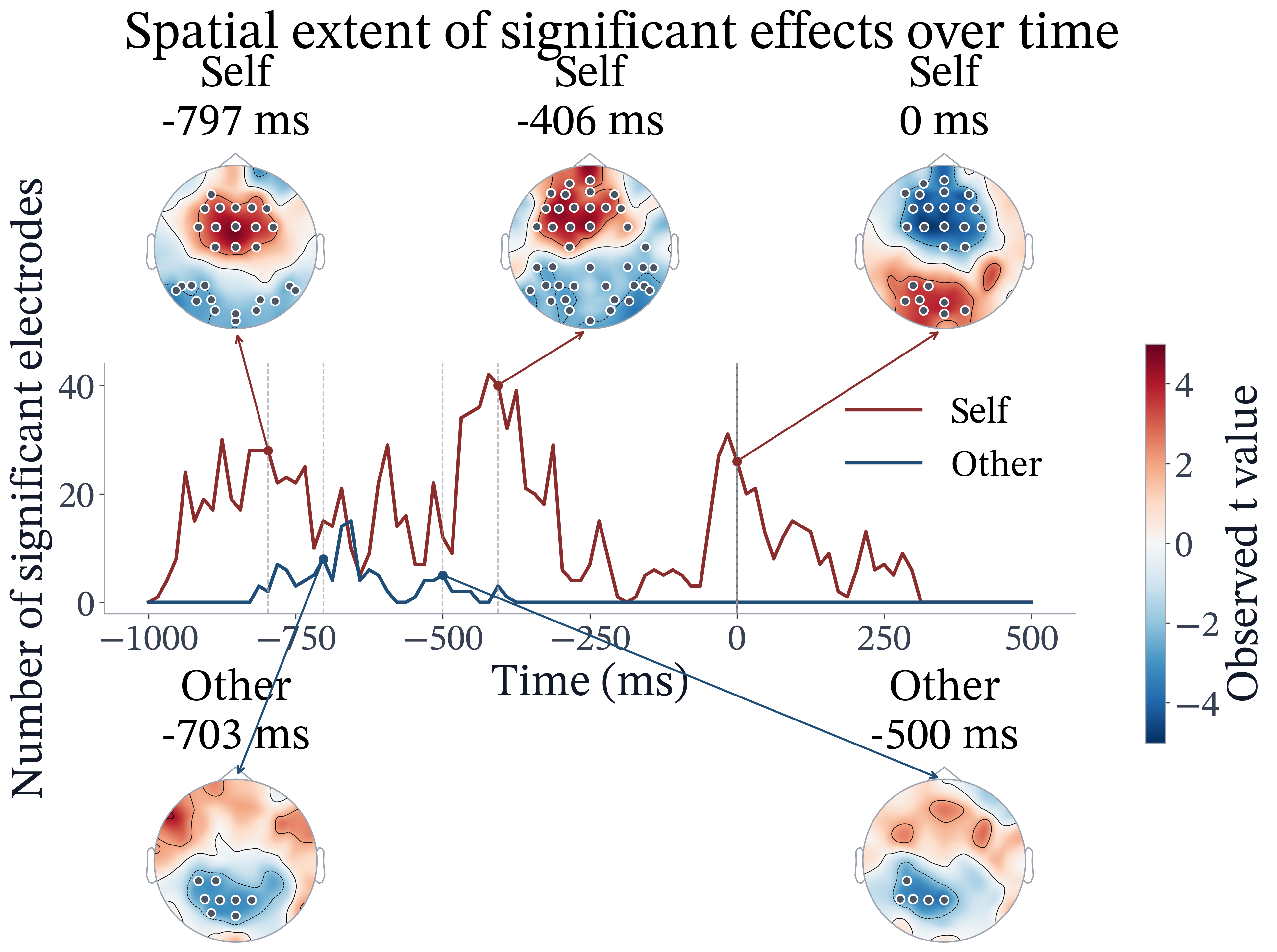
The neural results added an important twist. EEG activity before speech onset was related both to the speaker's own upcoming speech rate and to the partner's preceding speech rate. In other words, the brain activity during the listening period carried information about both what the participant had just heard and how they were about to speak.
However, these two neural patterns were not the same. The participant's own upcoming speech rate was associated more strongly with anterior, speech-preparation-like activity. The partner's speech rate was associated more with posterior activity, more plausibly related to listening and processing the incoming speech. Further analyses showed only limited overlap between the two patterns.
This means that behavioural alignment does not necessarily imply a single shared neural representation. Even though speakers converge in how fast they talk, the neural processes linked to hearing the partner's rate and preparing one's own rate appear to be partly distinct.
A useful way to think about this is that conversation relies on coupled systems rather than one common code. The brain may process the partner's speech tempo in one set of mechanisms, prepare the speaker's own tempo in another, and link the two through auditory-motor coordination. Alignment can therefore emerge from interaction between perception and production systems, without requiring them to look identical in the EEG signal.
More broadly, this work suggests that conversational alignment is real, but subtle. People do adapt to one another, especially over short timescales, but this adaptation may be implemented through dynamic coordination between partly separate neural processes rather than simple neural mirroring.