Conversation feels effortless, but it hides a difficult timing problem. In natural dialogue, people often respond within just a few hundred milliseconds after their partner stops speaking. Yet producing speech usually takes much longer than that. This means that, in many cases, we must begin preparing what to say while we are still listening.
In this study, we asked how the brain manages this overlap between listening and speaking. We recorded EEG from pairs of participants while they had spontaneous face-to-face conversations during a collaborative spot-the-difference task. Instead of using scripted dialogues or artificial button-press responses, we focused on natural turn-taking: when people actually began speaking, and how long their upcoming response lasted.
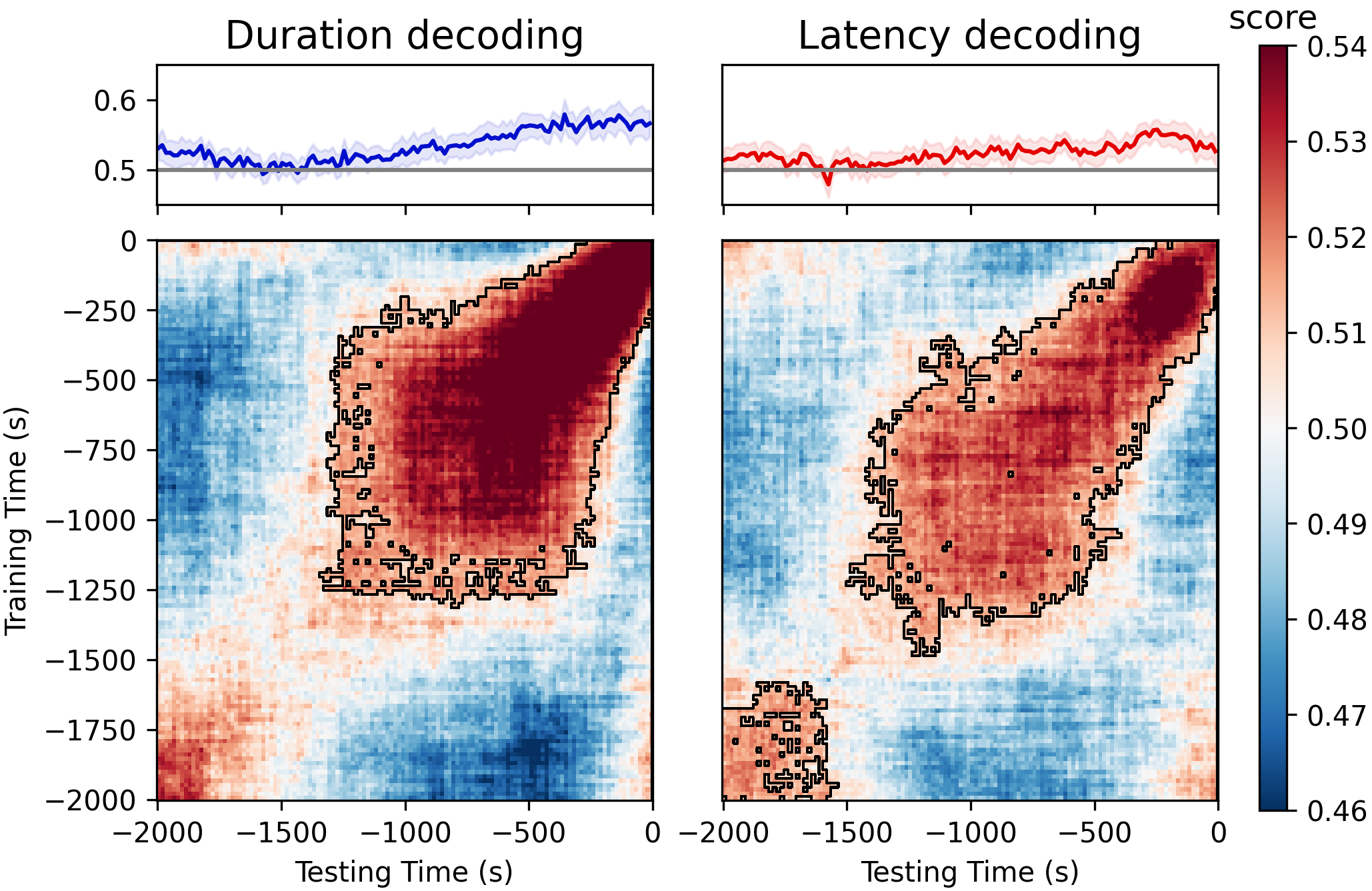
The main finding was that neural activity during listening already contained information about the speaker's next turn more than one second before speech began. Interestingly, the clearest early signal was not about exactly when the person would start speaking, but about how long their upcoming response would be. In other words, the brain seemed to carry information about the scale or extent of the planned response before articulation.
We found this pattern across several kinds of EEG analyses. Slow event-related brain activity, alpha and beta oscillations, and multivariate decoding all showed that upcoming speech behaviour could be predicted from pre-speech neural activity. Signals related to response duration were especially robust and sustained across the listening period. By contrast, signals related to response latency, the gap between one person finishing and the other starting, were more closely tied to the turn boundary itself.
These results suggest that conversational planning is not simply a last-moment process. Instead, it appears to unfold in at least two interacting stages. Early during listening, the brain begins to activate and maintain information about the upcoming response. Later, closer to speech onset, neural activity shifts toward commitment and motor preparation.
A useful way to think about this is that conversation requires us to keep two processes running at once: understanding the other person while preparing our own contribution. The present findings suggest that the brain can maintain a candidate response in the background during listening, then gradually move toward execution when the opportunity to speak approaches.
More broadly, this work shows that meaningful neural signatures of speech planning can be recovered from EEG recorded during real, face-to-face conversation. This helps bridge the gap between controlled laboratory studies of language production and the messy, dynamic reality of everyday dialogue.